Whether you are into Poe or not, this novel is nothing short of astounding. After burning through it as quickly as I could (which I ultimately regretted doing, since I was so sad when it was over) because it was so compelling and entertaining, I had to sit back and admire how much Pearl has achieved with this book.
Not only has he attempted to solve the mystery of Edgar Allan Poe's death (a mystery which has proven insolvable for over a century) by using clues and evidence that he has gathered through painstaking research, but he has also written one of the best historical novels of all time.
This is a compelling, brilliantly written, meticulously plotted novel that people will continue to talk and argue about for years to come. And as a bonus, it's also one hell of an entertaining ride. Unmissable.
Ahmed Khalifa is a filmmaker and novelist. He is the writer/director of several short films and a feature, which was released on Netflix, and the author of a number of novels and short stories, including the YA horror novel, Beware The Stranger, available on Amazon. He is also the host of The Dark Fantastic Podcast. Find him on Twitter @AFKhalifa and on Facebook @DFantasticPodcast
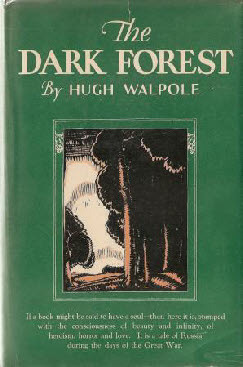
The Dark Forest is considered by many one of Hugh Walpole’s best novels. On the surface, it’s easy to see why. It deals with the always relevant subject matter of the effects of war on life, society, and the human soul. Walpole, ever the sentimentalist, would seem to be the ideal choice to write a tear-jerker about life in the trenches of battle, in war-torn Russia during the First World War. But Walpole as a person and as an author, was hard to pin down, and his take on the anti-war novel is somewhat different than one would expect.
The book tells the story of John Durward and John Trenchard, two Englishmen who join a company of Russian doctors working on the Russian side of the Eastern Front during World War I. Durward, the narrator, is practical and open-minded, and is arguably a stand-in for Walpole himself, while Trenchard is a dreamy, clumsy, and naïve man, who Durward at first dislikes, then slowly starts to grow fond of, foibles and all.
Part war journal, part love-story between Trenchard and his enigmatic fiancé, Marie Ivanova, part meditation on the nature of friendship and sacrifice, The Dark Forest is one of Walpole’s darkest and least accessible books, at least during its first half, with Walpole indulging himself, with excessive detail and a too deliberate a pace. But once the myriad elements of psychological drama, harrowingly realistic war scenes, and Walpole’s mastery of setting and atmosphere, start to gel, the novel turns into something bordering on the sublime.
Although Walpole proves himself more than capable of depicting the grim reality of war, it’s not his main focus here, as he seems more interested in the psychology of his characters - especially Trenchard - and why they do the things they do. He delves into concepts of valor, motivation, and the effect of love, both romantic and platonic, on the unimaginative man. And as the story builds and the horror mounts, the book slowly transforms into a sort of existential dark dream that ends on a devastating note.
It’s not a perfect book, and, in my humble opinion, not even one of Walpole’s best, with the main character, Durward, coming off as cold and forgettable, and, as usual with Walpole, the psychology can get a little too simplistic and clumsy. But as is also usual with Walpole, there are passages, images, and truths that transcend time and place, and the writing is occasionally so heartfelt, so honest, that one has no option but to surrender to its beauty.
The Dark Forest is a flawed and fascinating book, and one which signaled Walpole’s growing fascination with Russia, about which he would write several books, all fueled by his harrowing experiences as a volunteer for the Russian Red Cross in the First World War.
Ahmed Khalifa is a filmmaker and novelist. He is the writer/director of several short films and a feature, which was released on Netflix, and the author of a number of novels and short stories, including the YA horror novel, Beware The Stranger, available on Amazon. He is also the host of The Dark Fantastic Podcast. Find him on Twitter @AFKhalifa and on Facebook @Dark.Fantastic.AK·Writer
Bram Stoker’s seminal horror novel, Dracula, has inspired numerous sequels, prequels, re-imaginings, and stories focused on side characters from the book. What makes Dracula’s Demeter by Doug Lamoreux in some ways special, is its focus on the vampire count’s journey from his homeland to England onboard the Russian schooner, the Demeter. Stoker only dedicated a small portion of his novel to the events that take place on the Demeter, but Lamoreux uses every ounce of detail that Stoker provides and runs with it, creating an entertaining, compelling, if a bit stilted, novel, that is filled to the brim with nautical minutiae.
Lamoreux fleshes out the five characters only briefly mentioned in Stoker’s original book, and creates an original character of his own with a clever twist. And although it is a bit hard to tell who’s who in the first third of the book, by the second half, as events speed up and the violence escalates, the characters come into their own, especially the Scottish cook, and the English stowaway. Lamoreux’s version of Dracula himself is also notable, as this Count is no romantic figure. Lamoreux takes Dracula back to his original form, depicting him as a powerful, vicious, disgusting, brutally violent monster with no redeeming qualities whatsoever.
What stops the novel from becoming a horror classic is Lamoreux’s almost sole focus on storytelling. This is the kind of book that is almost all story, without enough emphasis on character. While the cast is likable enough, aside from the previously mentioned cook and stowaway, none of the characters really shine. Also, the book’s tone is slightly inconsistent, with the first two thirds playing out like a violent Gothic horror story, with graphic violence and a somewhat playful tone; while the last third of the story takes a darker, grimmer aspect. And Lamoreux’s choice of eschewing the epistolary format of the original novel, disconnects it stylistically from its source material, to a large degree.
But faults aside, Dracula’s Demeter is a fun, richly textured, Gothic horror novel, and is a must for fans of Stoker’s classic tale.
Ahmed Khalifa is a filmmaker and novelist. He is the writer/director of several short films and a feature, which was released on Netflix, and the author of a number of novels and short stories, including the YA horror novel, Beware The Stranger, available on Amazon. Find him on Twitter @AFKhalifa and on Facebook @Dark.Fantastic.AK·Writer
Hugh Walpole (1844-1941) was a prolific writer with a readable, compelling style, but whose sensibilities were somewhat limited. Almost all his books feature tortured, alienated characters, Gothic atmospherics, and a cynical, often downbeat undertone.
Inspired by Francis Thompson's haunting poem "The Hound of Heaven", The Prelude to Adventure (1912) features all of Walpole's signature ingredients, but what sets it apart is that, here, Walpole's main character is not lost, but found. Here, his lead character, a college student by the name of Olva Dune, a man who commits a murder in a moment of rage and then hears the voice of God calling him, is a man who has always felt out of step with the world until the moment of his crime, when he finds God, or rather, when God finds him. From there, the story focuses on Dune's struggle with that revelation, as well as his guilt and his fear of being unmasked as the killer. It's an unputdownable book written with surprising urgency by Walpole, who usually takes his time setting things up. It's also a successful cross-genre novel if ever there was one. It's a detective story, a Gothic tale, a spiritual meditation, and a love story all in one.
What makes the novel's effectiveness all the more surprising, is that its flaws are so apparent. Other than Dune and another character (Bunning, a lost soul who idolizes Dune), the rest of the cast are little more than sketches, and the plot progression and psychology are often clumsy. But work the novel does. It's a spellbinding book which aches with spiritual longing and the struggle to understand one's own darkness. No wonder Carl Jung praised it. It's a unique, fast-paced, moving story that ends on just the right note. Highly recommended.
Ahmed Khalifa is a filmmaker and novelist. He is the writer/director of the feature film Wingrave, released on Netflix, and the author of a number of novels and short stories, including the YA horror novel, Beware The Stranger, available on Amazon. Find him on Twitter @AFKhalifa and on Facebook @Dark.Fantastic.AK·Writer
Hugh Walpole's third novel, Mr. Perrin and Mr. Traill (1911), considered by many, and by the author himself, to be his best work, is a strange, somber, meandering, and unforgettable piece of literature.
Revolving around a feud between two school masters in a public school in Edwardian England, the book starts out as a slow-burn social drama about the tedium and oppressive nature of everyday life in the public school system, depicting an affecting if not exactly compelling series of incidents that almost outstay their welcome. But then the book's tone shifts to something much darker and much more fascinating, as it focuses on one of the character's headlong dive into regret, rage, and, inevitably, madness. Here, the book, which flirts with Gothic undertones from the beginning, transforms into a disturbing psychological drama, with the screws tightening faster and faster, till the poignant ending.
Walpole's prose ranges from sublime to serviceable. It has been noted by several scholars and students of his work that Walpole was an unfussy writer, to a fault, writing quickly and seldom revising the first draft. The outcome of such a method does the novel a disservice to some extent, with the pacing of the book, especially in the first half, being too unsteady, and the tonal lurches are also a distraction. But by the second half the narrative threads coalesce into a satisfyingly unnerving whole, with scenes of psychological torment so vivid they push the book right to the edge of a Gothic horror story.
The book has two endings, the original one published in Britain, and a revised one for the later American editions. Both endings are interesting, yet each is problematic in its own way. The original ending, though melodramatic, is more effective, more poignant, and much darker. The revised ending is clumsy, heavy-handed, and borderline didactic, but its more hopeful tone might appeal to some readers.
Mr. Perrin and Mr. Traill is a flawed piece of psychological fiction, with a cynical bent that can be hard to take at times. But, in the end, it is a novel that has stood the test of time, as there's emotional truth buried within its pages, and its depiction of a middle-aged man undergoing a calamitous transformation is harrowing and memorable. Recommended.
Ahmed Khalifa is a filmmaker and novelist. He is the writer/director of the feature film Wingrave, released on Netflix, and the author of a number of novels and short stories, including the YA horror novel, Beware The Stranger, available on Amazon. Find him on Twitter @AFKhalifa and on Facebook @Dark.Fantastic.AK·Writer
Written by Bram Stoker, and considered one of the most influential supernatural thrillers of all time... No, it's not Dracula. It's The Jewel of Seven Stars (1903), a dated and mostly stilted novel, but one which created the template for almost all subsequent stories that dealt with Egyptology and mummies.
The plot, about a band of men and one young woman in Victorian England who embark on an experiment to resurrect Queen Tera, a powerful Egyptian queen with otherworldly powers, is incoherent and at times painfully slow. But Stoker is a master of atmosphere, and his writings always have a fascinating obsession with the supernatural and the tensions between technology and superstition, religion and paganism, or as he describes it in the novel, "Powers, old and new". Despite its stagy nature, its two-dimensional characters, and its stiff dialogue, the story is compelling and has a doom-laden, eerie atmosphere, which culminates in an unforgettable and harrowing finale that was so upsetting to readers and critics upon its initial publication in 1903, that Stoker revised the novel for the 1912 edition, replacing the original finale with a nonsensical and impotent "happy ending".
The novel is now mostly remembered for its meticulous attention to detail in the sections dealing with Egyptology, its original central premise, and its harrowing ending. But it's not an easy read, as it features some of Stoker's most cluttered prose, and many chapters are repetitive and overlong. But for patient readers who like Victorian Gothic fiction and are interested in its development, it is worth the effort.
P.S. Most available editions are of the 1912 version, which should be avoided at all costs.
Ahmed Khalifa is a filmmaker and novelist. He is the writer/director of the feature film Wingrave, released on Netflix, and the author of a number of novels and short stories, including the YA horror novel, Beware The Stranger, available on Amazon. Find him on Twitter @AFKhalifa and on Facebook @Dark.Fantastic.AK·Writer
One of the most fun horror/dark fantasy novels in years, Stoker's Wilde is one wild ride, and a pleasure for fans of Gothic Horror and Victorian fiction.
The story takes Bram Stoker, freshly appointed as manager of the Lyceum Theatre in London, joins him with the foppish, contrarian, and pre-infamy Oscar Wilde, and pits them against an evil, supernatural enemy that is out for world domination. There are monsters, gore, plenty of action, and more than a modicum of humor, with appearances by a number of historical figures from the era, and nods to numerous horror classics, including the works of Stoker, Wilde, and even the Joss Whedon TV show Angel (1999-2004)!
The only caveat is that the novel's epistolary style, which channels the style of Stoker's Dracula, a purely Victorian, blood and thunder type of novel, doesn't always gel with the authors' agnostic/progressive tone.
But with a title like Stoker's Wilde, one knows the authors don't take themselves too seriously, and, ultimately, this is a novel written by horror fans for horror fans, who are bound to have a great time, thanks to straightforward prose, loads of imagination, and genuine affinity for the characters. Recommended.
Ahmed Khalifa is a filmmaker and novelist. He is the writer/director of the feature film Wingrave, released on Netflix, and the author of a number of novels and short stories, including the YA horror novel, Beware The Stranger, available on Amazon. Find him on Twitter @AFKhalifa and on Facebook @Dark.Fantastic.AK