Showing posts with label film review. Show all posts

Thursday, February 22, 2024

Film Review: KING OF NEW YORK (1990) *** and a 1\2 out of *****

Abel Ferrara is a maverick. Ever since he burst onto the scene in 1979, with his controversial punk slasher, Driller Killer, he has been making movies that are, in turn, stylish, thought-provoking, repulsive, and always fascinating.

Ferrara, dubbed the poet gangster of cinema, by actor Laurence Fishburne, has a tendency to overdo, to push things too far, sometimes to the detriment of the picture. But he rarely makes a film that is without merit, and is an artist to be reckoned with.

King of New York, released in 1990, is one of Abel Ferrara’s most accessible films. Part crime thriller, part social drama, it’s a strange and mesmerizing mishmash of genres and styles that is nothing short of compelling.

Frank White, played by a hypnotic Christopher Walken, is a former drug lord who returns to New York city after being released from prison, seeking to take total control of the criminal underworld, in order to give back to the community and help the poor of the city.

White, as played by Walken, is a fascinating character. Imagined by Ferrara to be a cross between Nicky Barnes, a Harlem gangster, and Joey Gallo, an Italian mobster, White is a brutal, complex figure, who revels in using force and violence, while seeing himself as a kind of dark knight in shining armor, who gives the poor and the lost, especially from black neighborhoods, a second chance, by recruiting them for his drug operation. He is an ends justify the means kind of guy, who would stop at nothing to achieve his goal.

Ferrara, and writer Nicholas St. John, try to tell a multifaceted story about the drug wars, government corruption, loyalty, and personal courage in the face of evil, and fill the film with characters that range from the realistic to the cartoonish.

Despite being shot quickly and on a modest budget of 5 point 3 million dollars, Ferrara, a visual stylist extraordinaire, manages to portray New York in the film in a way that is rarely shown in movies. As a beautiful, nocturnal landscape. Part noirish dream, part hellish nightmare. His vision of drug cartels as a kind of dressed to the nines tribal groups, who mostly speak through guns and violence, is alluring but somewhat fantastical, and his tendency to linger on the seedier aspects of criminal life borders on the distasteful.

But that is Ferrara’s style. Plenty of style, a dash of philosophical musing, and a touch of vulgarity. It’s a potent if not always palpable mix, that nonetheless makes his movies look and feel like no one else’s.

The terrific cast, led by Walken at his most ebullient and eccentric, includes an understated Wesley Snipes, and Laurence Fishburne, in an over the top but highly enjoyable performance.

Upon release, the film was criticized for its violence, and rightly so. As Ferrara’s tendency to push things too far and let some scenes overstay their welcome, is present here. And the sprawling story, covering a multitude of issues and characters in under two hours, make the film feel unevenly paced and, to some degree, tonally erratic. But these flaws don’t take away from the overall effect of the film, which is to mesmerize and captivate.

With the glut of movies made about the drug lords in the 1990s, King of New York stands out, because of its style, its sheer visual and aural power. It grabs you, and doesn’t let go, right up to its haunting final shot.

Text © Ahmed Khalifa. 2024.

Video Version:

Saturday, February 10, 2024

Before They Were Famous: Frank Darabont's Buried Alive

Frank Darabont, the Oscar-nominated writer director of such films as The Shawshank Redemption and The Green Mile, and the man behind the first season of the ground-breaking TV series The Walking Dead, cut his teeth writing horror films, like The Blob (1988) and A Nightmare On Elm Street 3: The Dream Warriors (1987).

But before he directed such critically-acclaimed films as the two aforementioned Stephen King adaptations, he made his directorial debut with Buried Alive, a TV movie produced for the USA cable network, and released in 1990.

On the surface, the film, about a woman who poisons her do-gooder husband to run away with her sociopathic lover, only to discover that her husband isn’t quite dead and is back for revenge, sounds like just another cheesy 90’s made-for-TV movie. Cue the bad synth score, the has-been TV actors struggling through their middle-ages crises, and the horrible dialogue. But, Buried Alive proves to be much more than that.

Milking the limited budget and the twisty script by Mark Peter Carducci for all their worth, Darabont injects this modest thriller with tons of energy, style, wit, and transforms what could have been a forgettable B-movie into a minor suspense classic.

Good performances by Tim Matheson, Jennifer Jason Leigh, and William Atherton, and the moody score by Michael Colombier, also help. But this is Darabont’s show, and you can see glimpses of his filmmaking prowess showing through the trappings he tries to transcend.

An atmospheric piece of American Gothic, Frank Darabont’s Buried Alive is worth rediscovering.

Text © Ahmed Khalifa. 2024.

Video Version of The Review:


Friday, August 25, 2023

Film Review: NEFARIOUS (2023) 2 and a half out of 5 stars.

A serial killer on death row. The day of his scheduled execution. A state-appointed psychiatrist comes to evaluate the killer's mental competency. If the inmate is found insane, a stay of execution will be issued. Problem is, the killer claims to be possessed by a demon named Nefarious, a manipulative evil entity that is out to spread a “dark gospel” to all of humanity. What follows is a psychological/philosophical game of cat and mouse between the psychiatrist, a man of science and an atheist, and an ingenious killer who may or may not be a servant of hell.

Nefarious (2023) has, excuse the pun, one hell of a set-up. Too bad it doesn't deliver.

From the opening scene, which features a not so subtle hint that there are otherworldly forces at play, it’s obvious that the filmmakers aren't really in total control of the film's tone. The main crux of the film is the discourse between the psychiatrist and the inmate. Such a set-up depends mainly on the quality of the dialogue and performances. In Nefarious' case, both are sadly lacking.

Sean Patrick Flannery, a capable and versatile actor, delivers a twitchy, grating performance as the killer slash demon, and his dialogue is so on the nose about the film's message of a new dark age brought about by corrupt institutions and radical leftist ideology, that by the midway point, the film has little to offer. Jordan Belfi, on the other hand, is miscast as the slick, complacent psychiatrist, whose materialist worldview is seemingly no match for the spiritual maneuvering of the killer. While the script does little to add depth to either character, or provide any plot twists that haven't already been done to death.

The direction, by writing/directing team Chuck Konzelman and Cary Solomon, is competent but uninspired, giving the film an amateurish, bland feel, mainly due to a lack of atmosphere and an engaging sound design, both of which are musts for a film of this genre.

I went into Nefarious really wanting to like it, as I'm always on the side of a good independent film that has the courage to go against the mainstream. But Nefarious is a hard film to defend, as it commits the cardinal sin of most faith-based, and rigidly ideological films: it preaches to the choir, while not doing enough to win over viewers with different politics or worldviews.

Text © Ahmed Khalifa. 2023.

Video Version:


Ahmed Khalifa is a filmmaker and novelist. He is the writer/director of several short films and a feature, which was released on Netflix, and the author of a number of novels and short stories, including the YA horror novel, Beware The Stranger, available on Amazon. He is also the host of The Dark Fantastic Podcast. Find him on Twitter @AFKhalifa and on Facebook @DFantasticPodcast

The Dark Fantastic is sponsored by VHS Books:


Friday, December 16, 2022

Film Review: Into The West (1992) *** out of *****

Written by Oscar nominated filmmaker Jim Sheridan, and directed by Mike Newell, the director of Harry Potter and The Goblet of Fire, and Four Weddings and a Funeral, Into The West (1992) , released in 1992, is a charming little family film that comes across as something Anthony Trollope might have written, with a dash of magical realism thrown in for good measure.

The story follows two young boys, Tito and Ossie, and their adventures when a beautiful white pony suddenly emerges out of nowhere and into their lives.

This was Director Mike Newell’s first foray into fantasy, years before finding massive success with Harry Potter and The Goblet of Fire (2005).

The film’s first half is almost flawless, depicting the poor with humor, humanity, and a dignity rarely seen in mainstream movies and the score by Patrick Doyle is gorgeous. But the second half stumbles quite a bit, with the villains coming off as mere caricatures, and the plot getting more and more far fetched and lazy.

But this is a sentimental, warm-hearted film for all the family, and one which has many moments of true magic.

Text © Ahmed Khalifa. 2022.

Ahmed Khalifa is a filmmaker and novelist. He is the writer/director of several short films and a feature, which was released on Netflix, and the author of a number of novels and short stories, including the YA horror novel, Beware The Stranger, available on Amazon. He is also the host of The Dark Fantastic Podcast. Find him on Twitter @AFKhalifa and on Facebook @DFantasticPodcast

Watch/Listen to the video version:


Thursday, November 17, 2022

Film Review: LOOKING FOR MR. GOODBAR (1977) ** and a 1\2 out of *****

 
(C) Paramount.
Released to much critical acclaim and box-office success, Looking For Mr. Goodbar (1977) encapsulates everything that was wrong with the excesses of 1970's cinema. Adapted from the controversial novel of the same name, Looking For Mr. Goodbar tells the story of Theresa, a young schoolteacher in 1970's San Francisco, who rebels against her strict Catholic upbringing by slowly descending into a life of casual sex, drugs, and bohemianism.

Richard Brooks, who adapted the novel for the screen, directs with a grimy, uncontrolled style, delivering a film that is morally and psychologically shallow, shrill, and borderline repugnant. Exploitive to the core, every minority under the sun is portrayed as either a victim or unstable, and Brooks' attempt at being "hip", by drowning the film in disco tunes and jump cuts, made the film look dated as soon as it was released.

Much has been said about Diane Keaton's performance as Theresa, the sexually adventurous/aggressive protagonist, and it is true that Keaton delivers a mesmerizing performance, but it is also a smug one, and a portrayal that doesn't wholly gel with the writing, producing a character that is equal parts unlikable and tragic. A young Richard Gere as a hyperactive gigolo, and Tom Berenger as a troubled and sexually confused ex-con, are the true scene-stealers in the film.

The epitome of 1970's "socially-conscious" dramas, this is a dated and unredeeming descent into nihilism and ugliness that is not deserving of its praise. Maybe that's the reason why the film has been so hard to find for many decades.

Text © Ahmed Khalifa. 2022.

Ahmed Khalifa is a filmmaker and novelist. He is the writer/director of several short films and a feature, which was released on Netflix, and the author of a number of novels and short stories, including the YA horror novel, Beware The Stranger, available on Amazon. He is also the host of The Dark Fantastic Podcast. Find him on Twitter @AFKhalifa and on Facebook @DFantasticPodcast

Watch/Listen to Review here:

Tuesday, October 11, 2022

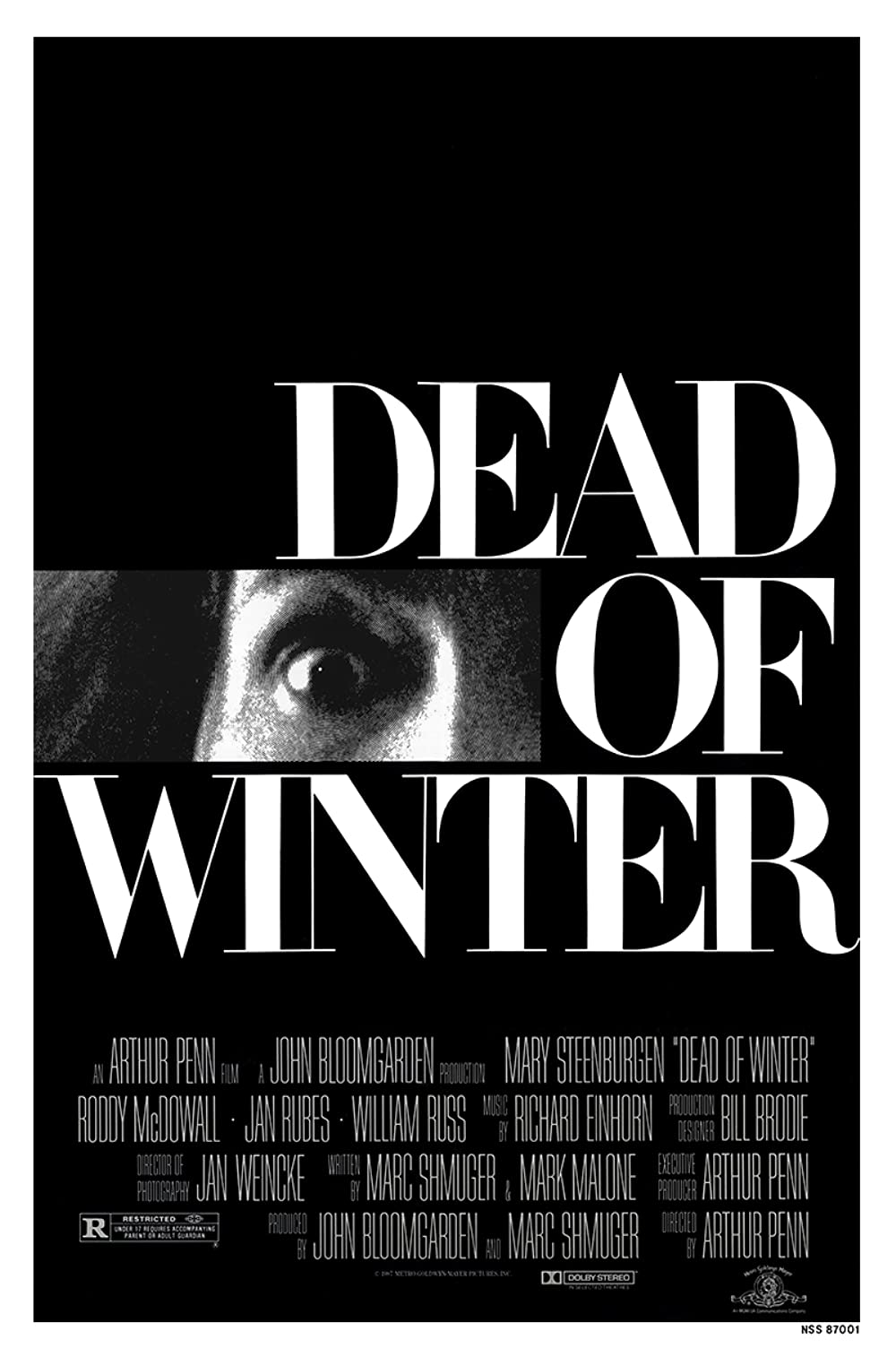
Quick Review: DEAD OF WINTER (1987) *** and a 1\2 out of *****

Compelling, atmospheric Gothic mystery, dripping with mood and menace, about a young, struggling actress getting embroiled with a couple of disturbed elderly men in an isolated old house during a winter storm. Roddy McDowell is terrific as a servile but unhinged assistant to Jan Rubes' charming - and over-the-top - psychopath. Arthur Penn directs with a steady hand, with lots of sly nods to Hitchcock, and Mary Steenburgen gives one of her better performances. The climax goes all-out Gothic shocker, and devolves into silliness, but, overall, this is a timeless suspense piece that is good for a chilly winter's night.


* A loose remake of Joseph H. Lewis's My Name Is Julia Ross (1945).

Text © Ahmed Khalifa. 2022.

Watch/Listen to review here:


Ahmed Khalifa is a filmmaker and novelist. He is the writer/director of several short films and a feature, which was released on Netflix, and the author of a number of novels and short stories, including the YA horror novel, Beware The Stranger, available on Amazon. He is also the host of The Dark Fantastic Podcast. Find him on Twitter @AFKhalifa and on Facebook @DFantasticPodcast

Sunday, April 3, 2022

Film Review: DEAD MARY (2007) *** and a 1\2 out of *****


(c) Peace Arch
This low-key, low-budget horror film is a strange creature. At a glance, it looks like an Evil Dead/Cabin Fever rip-off, with a bunch of young folk staying at a cabin in the woods for a long weekend, only to discover, after one of them is found brutally murdered in the woods, that there is an otherworldly killer amongst them. But as it turns out, Dead Mary is quite a bit more than that.

The film begins with a lengthy sequence introducing us to the cast of characters (which range from the unfaithful husband, to a guy who just broke up with his girlfriend, to the newbie girlfriend of one of the guys, who feels like an outsider, to the strong-willed young woman who flirts with the boyfriend of one of her friends), then shifts gears to become something similar to Invasion of The Body Snatchers, with a shape-shifting creature picking the characters off one by one. Then it shifts gears once more to become an apocalyptic thriller similar to The Thing. That's not to say that any of these aspects of the story is fully fleshed out or realized on a large scale. Far from it. This is a low-budget film, with almost no effects, and with minimal locations. So do the filmmakers pull it off? Yes. In spades.

Thanks to Robert Wilson's assured and stylish direction, which is pretty old-school, Peter Sheldrick and Christopher Warre Smets's solid script, and the young cast's earnest performances, the film turns out to be an effective and ambitious effort that manages to maintain the suspense throughout the whole running time, provide a couple of truly disturbing sequences, create an atmosphere of foreboding, and end on a darkly humorous and ambiguous note, things which many similar films with higher budgets fail to pull off (Cabin in The Woods, anyone?).

Although the plot is far from original, and the film has some pacing and script hiccups along the way, this is a minor classic that is entertaining and fresh.

Text © Ahmed Khalifa. 2011-2022.

Ahmed Khalifa is a filmmaker and novelist. He is the writer/director of several short films and a feature, which was released on Netflix, and the author of a number of novels and short stories, including the YA horror novel, Beware The Stranger, available on Amazon. He is also the host of The Dark Fantastic Podcast. Find him on Twitter @AFKhalifa and on Facebook @Dark.Fantastic.AK·Writer

Video Version:

Saturday, December 4, 2021

Film Review: CRY MACHO (2021) *** and a 1\2 out of *****

© WB\Malpaso
Clint Eastwood returns as actor and director with Cry Macho (2021), a sweet, gentle, and charming little film, which, in its own modest, easy-going way, achieves so much with seemingly little effort. But although Eastwood is a notoriously fast worker, his movies, with very few exceptions, are almost always a smooth ride, and easy on the eyes. Cry Macho is a prime example of these trademark qualities of an Eastwood film.

Cry Macho tells a simple tale: 1980. Texas. Mike Milo, a washed-up rodeo star and horse breeder, reluctantly agrees to help his ex-boss and benefactor to bring his half-Mexican teenage son home and out of his abusive mother’s reach. So he crosses the border to rural Mexico, finds the troubled boy, and, together, they journey back to Texas. But their journey takes an unexpected turn or two. The plot is little more than a collection of road-trip movie cliches, and the script, especially some of the dialogue, doesn’t really add much that is fresh or original to the mix. But Eastwood is a smart, restless filmmaker, and it’s easy to see why he was attracted to the material, despite its shortcomings. In his hands, Eastwood turns this tired script, which has been floating around Hollywood for decades, into an exercise in charming filmmaking.

From the endearing performance of most of the cast, especially Natalia Traven as Marta, the lovable den mother; and Eduardo Minett as Rafo, with his tough kid posturing and moving dedication to his pet rooster, Macho; and, of course, Eastwood himself, who gives himself one of his most likable characters in a long time as Mike Milo, everyone involved seems to be having a blast.

And, in many ways, Milo’s character, and the film itself, is spiritually linked to one of Eastwood’s favorite films, 1980’s Bronco Billy, about the leader of a wild west show, a middle-aged dreamer who loves show business, the old west, and horses. Milo could be Bronco Billy gone to seed. A burnt out man who has lost his hopes and dreams, and who, by befriending the teenage Rafo, a hopeless outcast like himself, starts to find his way again. No wonder Eastwood uses the same font he used on the Bronco Billy poster for the Cry Macho titles.

Cry Macho is a film out of time. A film that would have been right at home in the early 1980s or 1990s. Now, it’s understandable that it struggles to find an audience, at a time when nihilism is trendy, and negativity is bankable. But Cry Macho, despite its flaws, is a spellbinding, humane film that feels old and new at the same time, and is Eastwood’s best film in years. Highly recommended.

Text © Ahmed Khalifa. 2021.

Video Version:
 

Ahmed Khalifa is a filmmaker and novelist. He is the writer/director of several short films and a feature, which was released on Netflix, and the author of a number of novels and short stories, including the YA horror novel, Beware The Stranger, available on Amazon. Find him on Twitter @AFKhalifa and on Facebook @Dark.Fantastic.AK·Writer  

Tuesday, October 19, 2021

Film Review: SO LONG AT THE FAIR (1950) **** out of *****

Listen to this review:
Listen to "Movie Review: SO LONG AT THE FAIR (1950)" on Spreaker.

© Gainsborough Pictures

Reportedly admired by Hitchcock, who later adapted it twice for his TV show, Hitchcock Presents, So Long At The Fair (1950) is a highly effective period thriller.

The plot is a familiar one by now, variations of it appearing in many movies and TV shows, most famously in Hitchcock's The Lady Vanishes (1938). A young woman, Vicky, and her brother Johnny, travel to late 19th century Paris to attend the Exposition Universelle. Shortly after arrival, Johnny feels ill and retires to his hotel room early. The next day, Vicky wakes up to discover that her brother is nowhere to be found, his room gone, and that no one in the hotel seems to remember him ever being there. Has she gone mad, or is there something more sinister at play?

Fans of Hitchcock, and classic mystery fiction for that matter, will probably guess the solution to the puzzle long before the credits roll. But directors Terence Fisher and Anthony Darnborough keep things moving at such a brisk pace and with such technical elegance, that even if the viewer knows the outcome, the film remains absorbing and suspenseful. Most of the weight lies on Jean Simmons' shoulder as Vicky, and she handles it with aplomb, even if aspects of her performance are a bit of their time. And Cathleen Nesbitt as Madame Hervé, the conniving hotel owner, is a terrific villain. A young Dirk Bogarde is unimpressive, not having yet blossomed into the British art-house icon he would become in the 1960s and 70s.

Co-director Anthony Darnborough mainly worked as a producer throughout his career, but Terence Fisher would later become the wizard behind some of the best British Horror films of all-time, with his groundbreaking work with the iconic Hammer Studios, and elements of his controlled, visually fluent style are present here.

Even if the ending doesn't have the impact it should after more than an hour of superbly crafted build-up, So Long At the Fair remains a terrific thriller, and with a running time of just over 80 minutes, is a fast-paced watch. Highly recommended.

Text © Ahmed Khalifa. 2021.

Ahmed Khalifa is a filmmaker and novelist. He is the writer/director of several short films and a feature, which was released on Netflix, and the author of a number of novels and short stories, including the YA horror novel, Beware The Stranger, available on Amazon. Find him on Twitter @AFKhalifa and on Facebook @Dark.Fantastic.AK·Writer

Monday, March 1, 2021

Movie Review: HAMMER (2020) **** out of *****

Listen to this review:
Listen to "Movie Review: HAMMER (2020)" on Spreaker.

Clocking in at just over 80 minutes and slipping under the release radar, Hammer (2020) is an effective, quietly moving, and compelling psychological/crime thriller.

The plot: a ne'er-do-well son returns to his family home after a botched drug deal that resulted in the death of the dealer's girlfriend. Hunted by the dealer, the son, now accompanied by his father, embark on a race against time as they try to outrun the dealer and find a way to make things right.

But that whole plot is basically a "McGuffin", a device to get things going while co-writer/director Christian Sparkes gets to what's really on his mind: the complex dynamics of a family torn apart by guilt, flawed parents, seemingly unredeemable sons, and the vicious cycle of psychological scars being passed from one generation to the next like a bad gene. This is a thriller, no doubt about it, but it is a thriller with heart. Will Patton, as the conflicted father of a troubled son, gives an affecting, restrained performance, and one of the best of his career. Helped tremendously by Sparkes' dialogue, Patton portrays a character that is relatable, tragic, and somewhat off-putting at the same time. A father haunted by his own shortcomings, and the fear that he's unwittingly passed them on to his sensitive son, thus ruining his life.

But it is Mark O'Brien, as Chris, the troubled son trying hard to do better, who is the true heart of the film, delivering a performance that is naturalistic, truthful, and devastating. It is one of the year's best.

Hammer works as a psychological drama, as a thriller with realistic twists, and as a piece of minimalist cinema. It is a well-crafted, poignant, suspenseful film with a lot to offer, and it deserves much more notice and acclaim than it's got. Highly recommended.

N.B. The film is named after the director's father, to whom the film is dedicated.

Text © Ahmed Khalifa. 2021.

Ahmed Khalifa is a filmmaker and novelist. He is the writer/director of the feature film Wingrave, released on Netflix, and the author of a number of novels and short stories, including the YA horror novel, Beware The Stranger, available on Amazon. Find him on Twitter @AFKhalifa and on Facebook @Dark.Fantastic.AK·Writer


Tuesday, January 12, 2021

Movie Review: THE ASSISTANT (2019) **** out of *****

Saying too much about the plot of The Assistant (2019) does the film a disservice. Although it's not really plot-driven and more of a character study, part of the beauty of watching it is experiencing how it unfolds, scene by scene, layer by layer, drawing you in into a story that is masterfully and boldly told.

Centering on a newly hired assistant (Julia Garner) working for a major film producer, the film takes us through a day of her on the job, showing us her tasks, her experiences, and her attempts to do the work to the satisfaction of her demanding, unpleasant boss.

On one level, The Assistant is about what it is to be a young woman starting out in a job dominated by men; what it is to stick out, to be taken for granted and be treated as an object. These are important issues, but also ones that are perennially trendy and which are usually treated with bland political correctness. And had the film been just about that, it would have been an effective story about sexual harassment and the oppression of women in the work force. But what makes The Assistant a near-masterpiece is that it diverges from the pack in two major ways: The scope of the story, and the way it is told.

What writer/director Kitty Green achieves is nothing less than masterly. Green takes a seemingly simple story about a struggling young female assistant in a vicious corporate world, and turns it into a nuanced, subdued, almost Jamesian story made up of fascinating details. As we watch Julia Garner's character go about her daily tasks, we learn more and more about her, her environment, and the dilemma she's sinking into. Green, with admirable restraint, never crosses the line into preachiness or sentimentality, never loses control of the film's subtle but gripping tone, as she pulls us deeper and deeper into a story that is about much more than first meets the eye. As The Assistant is not just about the marginalization and exploitation of women in the workforce; it's also a haunting story of corruption, abuse of power, and conspiracies of silence.

And, of course, the whole film hinges on Julia Garner's performance, and it is a marvel. Garner, with very little dialogue, says much, projects much, and breaks our hearts.

Time will tell if The Assistant becomes a classic, although it should, as this is one of the boldest, most elegant psychological dramas to come out of Hollywood in years. And one which tells a tale worth telling, and tells it well. Highly recommended.

Text © Ahmed Khalifa. 2021.

Video Version:


Ahmed Khalifa is a filmmaker and novelist. He is the writer/director of the feature film Wingrave, released on Netflix, and the author of a number of novels and short stories, including the YA horror novel, Beware The Stranger, available on Amazon. Find him on Twitter @AFKhalifa and on Facebook @Dark.Fantastic.AK·Writer

Sunday, October 18, 2020

Film Review: GHOST STORY (1974) *** and 1\2 out of *****

Underrated British ghost story, surprisingly well-written, and dense with a macabre atmosphere. Performances are very good all around, and the story is effectively eerie. Technically, it's a little rough around the edges, presumably due to the modest budget and the location shooting in India (in place of the UK). But the steady direction and intriguing story keep things moving right up to the haunting ending. Highly recommended. Co-written and directed by Stephen Weeks.

Text © Ahmed Khalifa. 2020.

Ahmed Khalifa is a filmmaker and novelist. He is the writer/director of the feature film Wingrave, released on Netflix, and the author of a number of novels and short stories, including the YA horror novel, Beware The Stranger, available on Amazon.

Tuesday, September 29, 2020

Movie Review: ENOLA HOLMES (2020) ** out of *****

The first starring vehicle for the charming Millie Bobby Brown of Stranger Things fame, Enola Holmes (2020) is a disappointing and troubling film.

One knows something is amiss when the lead character, Enola Holmes, sister of Sherlock, starts talking to the camera, explaining her background. Breaking the fourth wall almost never works, and it doesn't here. For a little while after that, things progress a little better, with a seemingly admirable plot about female empowerment and following one's own path. But as the film moves forward, two things become apparent: that the script leaves a lot to be desired - characters aren't memorable and the plot drags - and that the film uses the Sherlock Holmes mythos as an excuse to tell a subversive, politically-charged story about so-called "social reform".

For a film aimed at children - it is based on the popular children's book series of the same name - there are dangerous and troubling ideas floating around here. Aside from the blatantly socialist/woke agenda of the film, where almost every upper class character is portrayed as villainous, where the police is corrupt, where every man is weak or rigid - Henry Carvill's portrayal of Sherlock Holmes might be the most boring and toothless in cinematic history - there's Enola's mother, who turns out to be a feminist terrorist who calls public bombings "making a little noise" to get results, and is positively portrayed as a good influence on her daughter!

Add to that that the film is blandly directed by Harry Bradbeer, and at two hours plus, it feels bloated and is difficult to get through.

For fans of Sherlock Holmes, this is a travesty. For children, this is a dangerous film with a subversive political agenda. And as entertainment, it fails miserably.

Text © Ahmed Khalifa. 2020.

Ahmed Khalifa is a filmmaker and novelist. He is the writer/director of the feature film Wingrave, released on Netflix, and the author of a number of novels and short stories, including the YA horror novel, Beware The Stranger, available on Amazon.

Sunday, December 20, 2015

Quick Review: ESCAPE FROM ALCATRAZ (1979)

Original Film Poster
One of the finest prison movies ever made, Escape From Alcatraz (1979) is a suspense masterpiece. It's masterfully directed by maverick filmmaker Don Siegel, with fine performances by Clint Eastwood, Fred Ward, Larry Hankin, and Patrick McGoohan, and a nuanced, well-written script by Richard Tuggle (who would later on direct Eastwood in the hit Tightrope (1984). This is an unmissable, compelling, near-perfect suspense picture, and arguably Eastwood's second best collaboration with Siegel after Dirty Harry (1971). Based on a true story.

Text © Ahmed Khalifa. 2015.

Monday, December 14, 2015

Review: THE GAUNTLET (1977)

Considered by many to be one of Eastwood's few failures, The Gauntlet has a lot to offer despite its flaws. Like the majority of films Eastwood directed in the 70's and 80's, it has an offbeat, original quality to it, which is rare for mainstream Hollywood films, especially ones with a star of Eastwood's caliber. In one sense, it's Eastwood's version of a blockbuster action-movie, filtered through his penchant for quirky storytelling and stories focusing on strong-willed, independent individuals and their battle against corrupt bureaucracies. But don't let all that fool you into thinking this is high-brow stuff. Not at all. The Gauntlet is mainly Eastwood having fun tinkering with the action/chase movie formula. And to some extent it works. Where it doesn't wholly work is in the credibility department. This is the kind of plot that requires Costco-sized doses of suspension of disbelief. But, considering the film's over-the-top tone and a comic-book inspired poster by Frank Frazetta featuring a muscled Eastwood, what did you expect? An entertaining misfire from a master filmmaker.

Text © Ahmed Khalifa. 2015

Saturday, February 16, 2013

Film Review: THE POSSESSION (2012)


The only reason I watched this movie was the involvement of Sam Raimi and his Ghost House company. That's not to say that Raimi and his production company have a great track record (Boogeyman, anyone?) But any horror film that involves Sam Raimi must have something to offer, right? Well...

As far as demonic possession/exorcist films go, The Possession is nothing very special. The first half is moody and well-paced, with the family drama, about a family going through a divorce, serving as an effective backdrop for the slowly building supernatural shenanigans. But the second half, where all the spooky stuff takes place, is of the been-there-done-that variety. Director Ole Bornedal (Nightwatch) knows how to create stylish visuals and get good performances from his cast, but the plot offers almost nothing new, aside from exploiting the Hasidic side of exorcism rites (instead of the usual Catholic imagery audiences usually associate with this kind of film).

Overall, this is a mildly entertaining horror film, with a couple of memorably scary sequences. But the plot is cliched, the turn of events familiar, and the final scene especially ho-hum. And did anyone else notice that a crucial plot device is lifted from Ruby Jean Jensen's novel, Death Stone, about a young girl getting possessed by wearing a cursed ring?

Text © Ahmed Khalifa. 2013

Ahmed Khalifa is a filmmaker and novelist. He is the writer/director of several short films and a feature, which was released on Netflix, and the author of a number of novels and short stories, including the YA horror novel, Beware The Stranger, available on Amazon. Find him on Twitter @AFKhalifa and on Facebook @Dark.Fantastic.AK·Writer

Sunday, September 4, 2011

The Overview: FROM THE CORNER OF HIS EYE - FRIGHT NIGHT (2011)

© Bantam
Book Review: From The Corner of His Eye by Dean Koontz:
Dean Koontz can be a hell of a frustrating author sometimes. Some of his books are superb, filled with imagination and storytelling prowess, driven by inventive central concepts and an irresistible atmosphere of menace. On the other hand, some of his books, especially ones published later in his career (from the mid-90's, onwards), are so repetitive, preachy, and thinly plotted, that one wonders how they could have been written by the same man. From The Corner of His Eye is one of the good ones. In fact, it's one of the very good ones. It combines Koontz's masterful ability to keep the reader intrigued, turning the pages effortlessly, with a plethora of imagination and likeable characters and a plot that defies categorization.

The plot: Junior Cain, a handsome young man with a twisted mind, throws his wife off a cliff to inherit her money. After her husband dies in a car accident, Agnes Lampion gives birth to a young boy who grows up to be a prodigy with a strange and magical ability to glimpse other realities that exist parallel to ours. After getting raped by a white man, Phimie White, an African-American young woman, gives birth to a baby girl, Angel, and dies in the process. Detective Tom Vanadium, an enigmatic man with a penchant for unnerving murder suspects with his mind-boggling coin tricks, doesn't believe that Junior Cain's wife's death was accidental, and so embarks on a journey to harass the prime suspect, her husband, till he breaks and confesses. Together, all those people's live are about to intertwine, with consequences that might change the face of the world we live in.

I know the synopsis is murky. But to tell any more of the plot would be unfair to you and to the book's wonders. As part of the thrill of reading this lengthy novel (it's over 700 pages long) is unravelling the layers of the plot one by one, discovering surprises, some pleasant, some disturbing, along the way.

Although Koontz gets on his soapbox one time too many, and the novel is about 100 pages too long, these flaws don't detract from the fact that this is a wonder of a novel; a book filled with stories within stories and memorable characters. The novel is also one of Koontz's most tightly plotted in a long time, with one delicious twist leading to another. And despite Koontz's genre-hopping (the book is part Sci-Fi, part mystery, part ghost story, part love story, and part historical novel!), he pulls it off, delivering a book that has a satisfying ending and is never confusing.

So who is this book for? Fans of Koontz, of course, are the primary audience here, as, by now, they are used to his style and his penchant for juggling genres. But it's also a good introduction to Koontz, a good choice for people who like long, multi-layered novels, and readers who like their novels atmospheric, fast-paced, and well-plotted. No matter what your preferred genre is, this is must-read book, that's entertaining, humane, suspenseful, and immensely rewarding. One of Koontz's best.