Showing posts with label Dean Koontz. Show all posts

Thursday, November 27, 2025

Book Review: The Forest of Lost Souls. By Dean Koontz. *** and a 1\2 out of *****


Powerful, affecting story, about a young woman who has her quiet life turned upside down after her fiance is murdered, and she stumbles upon a plot by an evil billionaire to take by force a piece of forested land near her home.

The Forest of Lost Souls is one of Koontz's best and most thought-provoking books, despite a slow start, and Koontz’s penchant for preaching and cute characters.

Koontz uses a simple premise as a launching pad to delve into the worlds of mythology, righteous violence, totalitarian states, and most importantly, faith.


It features many of Koontz’s usual obsessions (the dark side of technology, the cost of necessary violence, the dilemma of the conscientious in a fallen world), but still feels fresh and full of life, with vivid writing, an accelerating pace, and interesting characters.

And although the ending is somewhat abrupt, his writing here is some of his most transcendent and ebullient; a somewhat remarkable achievement for a writer at this late stage in his career.

The Forest of Lost Souls is a must for Koontz fans, and a great introduction to the author’s work for newcomers.

Watch or Listen to Video Version:

Saturday, July 29, 2023

Book Review: THE TAKING by Dean Koontz. *** and a 1\2 out of *****

From the late 1990s onwards, the work of Dean Koontz took on a somewhat jarring tone. Novels like Sole Survivor (1997), One Door Away from Heaven (2001), Odd Thomas (2003), and Innocence (2013), were all repetitive thrillers about lost characters in search of redemption, or innocent characters hunted down by irredeemably evil figures, with most of the stories having a religious undercurrent that could be pretty off-putting. Some of these books worked. Many of them didn’t.

Since The Taking, originally published in 2004, seemed more of the same, I dove into it with low expectations, giving it a go mainly because, in an interview with Koontz that I came across recently, he mentioned that he considered The Taking one of his all-time favorite books.

The Taking revolves around Molly and Niel Sloan, who wake up in the middle of the night to the sound of pouring rain, a cataclysmic downpour that threatens to drown their small California town. Quickly, the young couple senses that something tremendous is going on, maybe even the end of the world as they know it. So they venture out of the safety of their home, and seek their neighbors, feeling the need to band together against this otherworldly threat. But they soon come to realize that their neighbors are not what they seem, and that what’s going on surpasses their worst nightmares.

The Taking is Koontz going full-throttle, for better or worse. The book is immensely readable, a true page-turner, and the main character, Molly, is a likable, vulnerable, but innately strong character. But Koontz’s penchant for heavy-handed prose and preachiness also shine through, and he seems more interested in atmosphere and creating a sense of cosmic dread, than in structuring a satisfying plot.

And that’s the thing about The Taking: it’s virtually plotless. The whole story revolves around a concept, not a plot, of seemingly omnipotent and malevolent beings taking over the world, and how Molly and her husband deal with that. There are some interesting sidetracks, and the dialogue is crisp throughout, but the book feels like a short story or a novella expanded into a novel.

That isn’t necessarily a bad thing. And The Taking isn’t a bad book. In fact, it’s a very good one, and, surprisingly, turns out to be one of Koontz’s best, mainly because of Koontz’s ability to hone in on his obsession and fascination with the concept of pure evil, and how good people confront it.

The Taking is a truly disturbing descent into a hellish situation, into a world subverted by evil and paranoia. And even if the scale of the story isn’t as epic as it pretends to be, the imagery, the philosophical implications, and the final revelation make this a haunting metaphysical thriller that leaves a lasting impression and plenty of food for thought.

Recommended for fans of the author and for newcomers alike.

Watch/Listen to the video version, here:


Text © Ahmed Khalifa. 2023.

Ahmed Khalifa is a filmmaker and novelist. He is the writer/director of several short films and a feature, which was released on Netflix, and the author of a number of novels and short stories, including the YA horror novel, Beware The Stranger, available on Amazon. He is also the host of The Dark Fantastic Podcast. Find him on Twitter @AFKhalifa and on Facebook @DFantasticPodcast


Saturday, August 27, 2022

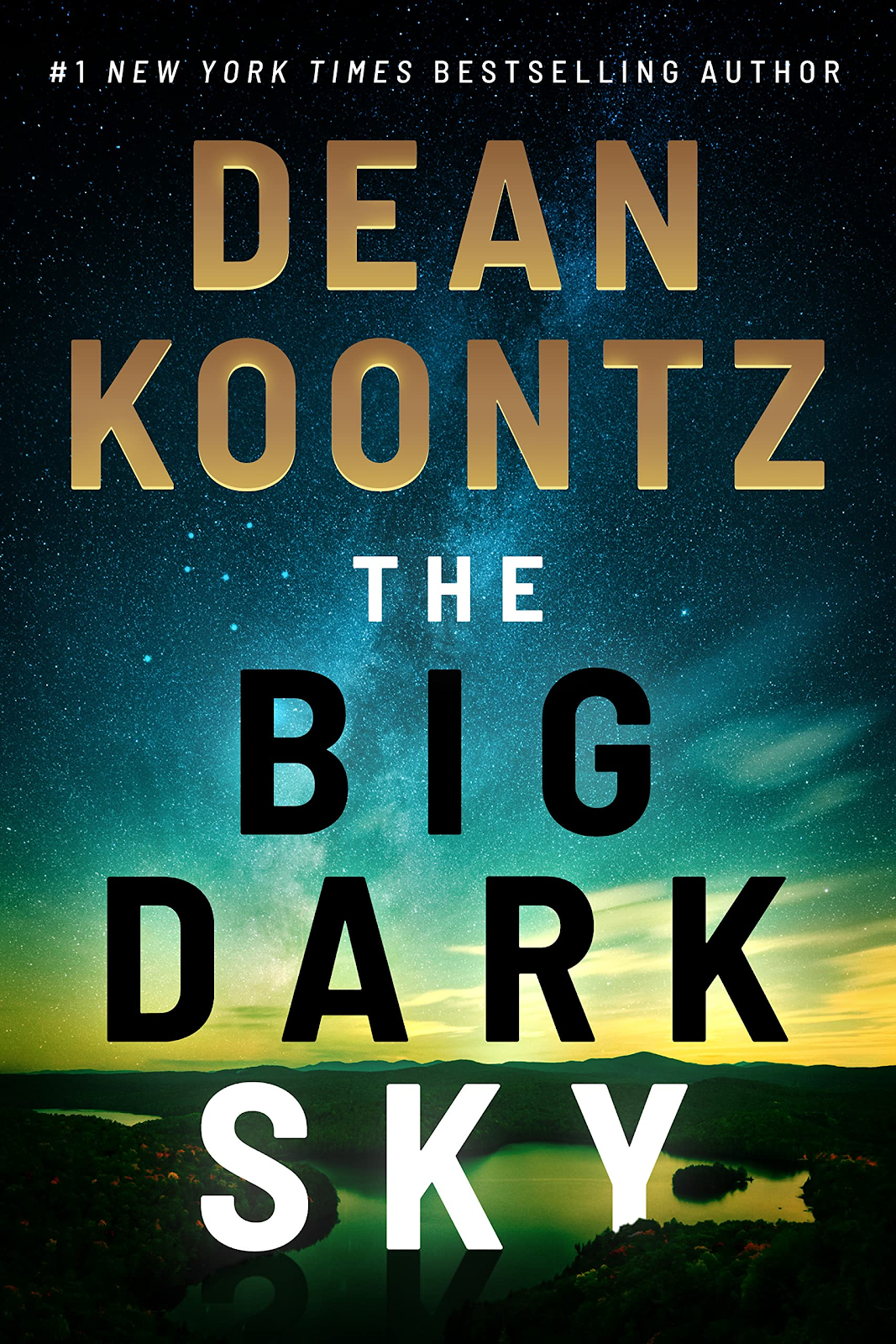
Book Review: THE BIG DARK SKY By Dean Koontz. *** and a 1\2 out of *****

(c) Amazon.

Dean Koontz returns to some of his favorite themes in The Big Dark Sky, letting his obsessions, fears, and hopes all come through loud and clear. And in doing so creates one of his most effective and memorable novels in years. Although Koontz came close with his wonderful novel Devoted, published in 2020, The Big Dark Sky is a better, more nuanced book in many ways. It is also much darker.

The plot: A group of people from different backgrounds has converged at a remote ranch in Montana. Each person has a reason to go there, from facing painful childhood memories, to investigating a series of strange phenomena, to escaping from a seemingly omnipotent killer. Each one of them is haunted, seeking answers to questions they can no longer ignore. Meanwhile, on the outskirts of the ranch, a disturbed visionary works on completing his manifesto of terror and mass murder, unaware that his fate is also connected to the ranch and the people headed there.

With echoes from some of his earlier books, especially Phantoms, Strangers, and Demon Seed, Koontz delivers a tale that is compelling, wondrous, and disturbing. It has a questioning, marveling quality and a nasty, darkly witty edge that have been missing from his books for years.

It isn't a perfect book, though, with a number of slow-going chapters near the beginning of the book, and a short slump around the middle section. But for the most part, the writing is crisp, the main concept fascinating, and the characters likable. And the villain is one of the most terrifying creations of Koontz's career. Highly recommended for fans and newcomers alike.

Watch/Listen to review here:


Text © Ahmed Khalifa. 2022.

Ahmed Khalifa is a filmmaker and novelist. He is the writer/director of several short films and a feature, which was released on Netflix, and the author of a number of novels and short stories, including the YA horror novel, Beware The Stranger, available on Amazon. He is also the host of The Dark Fantastic Podcast. Find him on Twitter @AFKhalifa and on Facebook @DFantasticPodcast

Friday, April 22, 2022

Book Review: QUICKSILVER By Dean Koontz ** and a 1\2 out of *****

Listen to the review:
Listen to "Book Review: QUICKSILVER By Dean Koontz." on Spreaker.
(c) Amazon.
Quicksilver is a problematic book to review, to say the least. It's Koontz mostly on autopilot, rehashing themes, ideas, and plotlines that he's always been obsessed with. It's a "tell" book, not a "show" book, meaning that Koontz tells the story mostly through dialogue. 

The plot is slight: a young journalist who suddenly finds his life turned upside down when two mysterious men in black try to kidnap him. From there, he is hurled into a strange adventure that involves guns, monsters, and horrific visions. Koontz basically uses this threadbare and tired concept to wax poetic on the horrors of nihilism, totalitarianism, and the weight of personal courage in times of mass evil. The tone shifts from funny, to preachy, to, ultimately, troubling violence, leading to a tepid ending.

Surprisingly, it builds to a somewhat dark last third that is relatively affecting, with a shift of tone that some might find jarring.

Overall, it's an uneven, overlong, forgettable novel, but one which has something of value to say, even if it takes its sweet time and oodles of self-indulgence on Koontz's part to get there.

Text © Ahmed Khalifa. 2022.

Ahmed Khalifa is a filmmaker and novelist. He is the writer/director of several short films and a feature, which was released on Netflix, and the author of a number of novels and short stories, including the YA horror novel, Beware The Stranger, available on Amazon. He is also the host of The Dark Fantastic Podcast. Find him on Twitter @AFKhalifa and on Facebook @Dark.Fantastic.AK·Writer

Friday, April 8, 2022

Book Review: CAGE OF NIGHT By Ed Gorman. **** out of *****

Listen to the review:
Listen to "Book Review: Cage of Night by Ed Gorman" on Spreaker.

(c) PS Publishing

Ed Gorman is a master. During the 1980’s and 90’s, his books were constant “mid-listers”, which means somewhere in the middle of the bestseller lists. He never had a huge hit (like some of his contemporaries Stephen King, Peter Straub, and Dean Koontz), but his short, infinitely readable novels were – and still are – a treasure trove for the discerning reader. Cage Of Night is no exception.

Written in Gorman’s minimalist, smooth prose, and comprised of short, punchy chapters, this is a mesmerizing, haunting, and endlessly compelling tale about a young man returning from his sojourn in the military, to his small home town, only to get entangled with a seductive young woman, who may or may not be insane. And what is that entity dwelling in that old well that calls for him? To say any more about the plot would be unfair to the book and the reader, but suffice it to say, this is a brilliantly crafted tale of suspense, with a dash of Jamesian psychological horror to spice things up.

If you’ve missed Ed Gorman, you’ve missed something very special, and Cage of Night is a fine example of what this talented author has to offer. Highly recommended for fans of Dean Koontz, Ira Levin, Charles L. Grant, and Cornel  Woolrich.

Text © Ahmed Khalifa. 2014 - 2022.

Ahmed Khalifa is a filmmaker and novelist. He is the writer/director of several short films and a feature, which was released on Netflix, and the author of a number of novels and short stories, including the YA horror novel, Beware The Stranger, available on Amazon. He is also the host of The Dark Fantastic Podcast. Find him on Twitter @AFKhalifa and on Facebook @Dark.Fantastic.AK·Writer


Monday, January 3, 2022

THE DARK FANTASTIC'S BEST DISCOVERIES - 2021 EDITION

Books:

© Berkley

1- THE VOICE OF THE NIGHT By Dean Koontz. : First published in 1980 under the pseudonym Brian Coffey, and later released under his own name in 1991, The Voice of The Night is one of Dean Koontz’s best, yet least known, novels. It is one of his most understated books, and his only coming-of-age tale. Read or listen to the full review here.

Sunday, January 2, 2022

Book Review: NAMELESS: THE COMPLETE SERIES. By Dean Koontz *** out of *****

© Amazon.

A literary experiment comprised of 12 interconnected novellas, about an amnesiac vigilante who hunts down killers who have escaped the grip of the law. This is Koontz at his darkest and angriest, a side of him that readers rarely get to see, especially in the past 30 years or so. The main character is interesting if too enigmatic for his own good, and the 12 stories vary in quality and style. The first season is more episodic in nature, which makes for a somewhat uneven bunch of tales, but with each installment the main story, of the secrets behind Nameless's mission, gets darker and more exciting, all leading up to an ending that, though not very surprising, is powerful and moving, if a bit troubling in its implication that violence maybe inescapable and comes at a high cost. A must for Koontz fans, and a perfect introduction to readers new to his work.

Text © Ahmed Khalifa. 2022.

Video Version:


Ahmed Khalifa is a filmmaker and novelist. He is the writer/director of several short films and a feature, which was released on Netflix, and the author of a number of novels and short stories, including the YA horror novel, Beware The Stranger, available on Amazon. Find him on Twitter @AFKhalifa and on Facebook @Dark.Fantastic.AK·Writer

Wednesday, December 8, 2021

Book Review: THE VOICE OF THE NIGHT By Dean Koontz. *** and a 1\2 out of *****

© Berkley

First published in 1980 under the pseudonym Brian Coffey, and later released under his own name in 1991, The Voice of The Night is one of Dean Koontz’s best, yet least known, novels. It is one of his most understated books, and his only coming-of-age tale.

The story, about Colin, a 14 year-old outcast who befriends Roy, the coolest kid in town, only to find out that his new friend might be a psychopath, isn’t original, but Koontz has a lot more on his mind than delivering a mere suspense novel, although The Voice of The Night works quite well as one.

Koontz, who has been very open about his childhood traumas involving parental abuse, writes here with a candor, with an urgency, that is rare in his work. On the surface, this is a compelling page-turner about a child’s loss of innocence, and the realization that the world is a much darker place than previously imagined. Colin, a “geeky” teen, who spends his time reading horror and sci-fi to escape his loneliness, is a wonderfully drawn character. He is likeable, vulnerable, and real. Which makes his rude awakening all the more heartbreaking. Slowly, as Roy reveals one layer of his psyche after another, Colin starts to see what his friend, and the world, are really like. Ghouls, monsters, and aliens are good for a brief glimpse into a darkness imagined, but true human evil is an abyss.

This is heartfelt stuff, as Koontz vividly and realistically paints an honest picture of a lonely, alienated boy, starved for attention and companionship. His father is an aggressive, gruff man, who bullies his son for being sensitive; and his mother is a self-involved, absentee parent who doesn’t really make the effort to understand the complex nature of her son and his worries.

Koontz’s writing here is solid, unfussy, and, for the most part, confident. The dialogue flows smoothly, capturing the combination of innocence and vulgarity that is unique to teenage conversations. And his command of atmosphere is impressive, conjuring an evocative feel for the small California town, its beauty, its dark secrets, with a few clear sentences, unlike the verbose, and occasionally trying, style he would later adopt in many of his novels from the mid 1990s onward. The plotting is a bit bumpy, and Roy is never fully realized as a believable villain. While the ending, though hard-hitting, is a bit rushed. But the closing lines are both moving and disturbing.

The Voice of The Night is one of the few novels where Koontz faces the dark full on, with only a glimmer of hope. It is one of his rawest, darkest books, and one of the best American horror coming-of-age novels to come out of the 1980s, preceding, and, in many ways, surpassing, the Stephen King novels dealing with similar themes that would make King one of the most popular writers of all time. Highly recommended.

Text © Ahmed Khalifa. 2021.

Video Version:


Ahmed Khalifa is a filmmaker and novelist. He is the writer/director of several short films and a feature, which was released on Netflix, and the author of a number of novels and short stories, including the YA horror novel, Beware The Stranger, available on Amazon. Find him on Twitter @AFKhalifa and on Facebook @Dark.Fantastic.AK·Writer

Thursday, November 25, 2021

10 Great Horror Novels You (Probably) Don't Know About

Horror fans are always looking for something new to watch, read, or listen to. There are “best of” lists aplenty, with each list focusing on a certain sub-genre or category. With this list, I am going to include ten books that I greatly admire, for several reasons, and which I think haven't got their due. I think even ardent fans of the genre will find a number of surprises included here.

1- CUTTHROAT by Michael Slade: Cutthroat by Michael Slade, is a superbly entertaining thriller. Violent, atmospheric, bizarre, and highly original, this novel about a special team of Canadian investigators hunting a seemingly invincible assassin, crosses genres with surprising ease, and ends with one of the strangest climaxes I've ever come across.

Tuesday, October 12, 2021

Introducing THE DARK FANTASTIC PODCAST

If you're a constant visitor to this website, then you know it's dedicated to all things movies, books, and TV, especially hidden gems in all genres.

We have now launched The Dark Fantastic Podcast, an expansion of what is featured on the site, with exclusive audio short stories, and interviews with writers, filmmakers, and creators in all fields.

This latest episode, features Ahmed Khalifa talking about why he thinks Dean Koontz is, in some ways, better than Stephen King; a brief history of pulp fiction's greatest character, The Shadow; and an exclusive interview with author Will Murray, whose latest book, Master of Mystery: The Rise of The Shadow, is out now. Enjoy!

Listen to "Episode 2: Dean Koontz Returns and The Shadow Rises, W\Author Will Murray" on Spreaker.

Saturday, January 2, 2021

The Dark Fantastic Interview with author Robert J. Randisi (Author of The Rat Pack Mysteries and Curtains of Blood)

Robert J. Randisi is one of the most prolific writers in history, having authored hundreds of  published books and edited more than 30 anthologies of short stories. He co-founded and edited Mystery Scene magazine (with Ed Gorman) and co-founded the American Crime Writers League. He founded The Private Eye Writers of America in 1981 and created the Shamus Award.

In a 2011 Barnes & Noble interview he revealed that he writes under sixteen pseudonyms, and that he produces fifteen books a year, with 1984 being his most prolific year, with an output of twenty seven books!

He is most renowned for his mystery fiction (Dean Koontz and Michael Connelly are fans of his work), which includes The Rat Pack Mysteries, the Nick Delvecchio series, and the Joe Keough series.

Randisi has also written hundreds of western novels - including The Gunsmith series, The Tracker series, The Angel Eyes series, among others - and dozens of stand-alone novels in numerous genres.

Author Robert J. Randisi

I had a chance to interview him recently and ask him about his prodigious output, his style, and one of my all-time favorite novels, Curtains of Blood.

How early in your life did you discover that you wanted to be a writer?

I was 13 when I first put pen to paper—or fingers to a typewriter—but I was 15 when I decided I would do it full time for a living by the time I was 30—and I did. 

Early in your career, your worked for the NYPD. What was that experience like, and how did it influence your writing?

It was an eye opening experience, a peek into real life that I hadn’t seen before. At 23 I’d have to say it was life altering.  It did enable me to write more realistically about people, but except for a short story or two it didn’t actually influence my writing until I wrote ALONE WITH THE DEAD in 1995.

P.I. fiction has definitely stood the test of time and continues to be popular to this day. In your opinion, what makes P.I. fiction such a sturdy and timeless genre?

I think the loner standing against the masses is timeless.  We all like to think we could do it if we had to. It’s something that connect the Western and the Private Eye story, the lone gun who’s not on either side of the law, but sort of straddling the line in the middle. He’s heroic, and almost everybody would like to be a hero.


I think it's safe to say that you're one of the most prolific writers of all time, with hundreds of novels in countless genres under your belt. To what do you attribute your prodigious output, and what is your writing process like?

I can only attribute my output to my absolute love of writing. Most of my waking hours are spent writing. And I discovered at an early age that I had an unusual ability to write swiftly. I was advised by other writers early on NOT to write quickly, to slow down. But when I tried to follow that advice it affected everything—my output and the quality of my work. So I had to settle down into my natural pace, which is the advice I give to writers when they ask. Find your natural rhythm, and stick with it. And remember, I wanted to write for a living by the time I turned 30. That meant writing a lot of books, or becoming Stephen King—and I ain’t Stephen King.  

Do you have a favorite genre to write in?

For me it is and always has been the Private Eye genre—even  before it was accepted as a genre of its own, rather than the sub-genre of the mystery. It became part of my life’s work to make that happen.  

As the creator of the Shamus Award, and an expert in P.I. lore and methodology, did you ever think of becoming a P.I. yourself?

Early in my life, yes. Dealing with police detectives and meeting some private eyes along the way, I thought about it, but that would have interfered with the writing. I was a musician in my teens, and decided I’d have to either pursue music or writing to succeed at one of them. You know what I chose. But yeah, I think I could’ve been a good P.I.


Who are your favorite writers, the ones that inspire you the most?

I go cross genre with influences, from Chandler and Ross Macdonald to Roger Zelazney and Keith Laumer. I enjoyed them, and learned from them. And I was mentored by Warren Murphy, who gave me my first writing job.  These days I enjoy the work of Michael Connelly very much. He’s one of the few writers I think actually deserves his success status. 

Your style can arguably be called minimalist: You achieve so much with so few words, and your sentences are always lean and drive the story forward, which makes most of your books on the shorter side, yet wholly satisfying as novels. What attracts you to this spare style?

It’s not conscious, it simply comes naturally. I don’t rewrite, the story comes out of my head and flows through my fingers at a certain speed, and the “minimalist” style you refer to just fits.  I’m much more concerned with the action of the story, than I am with the kind of shoes characters are wearing, or what the weather’s like. I’m as much criticized for that as I am praised, but once again, you have to go with what comes naturally. 

Your mastery of almost all genres is mind-boggling. Is that the result of your interest in a wide-range of subjects? Or are you just a voracious reader?

Oh, I was a voracious reader from an early age, and kept looking for more and more to read, which meant bringing new genres into the fold. I have to say the only genre I’ve never read or written is the romance. The private eye is still my favorite genre to read, but some of my favorite books have come from Roiger Zelazney and Frank Herbert.

One of my favorite novels of yours is CURTAINS OF BLOOD, a terrific historical thriller in which Bram Stoker crosses paths with Jack The Ripper, a concept which has been used many times, with varying degrees of success. In my opinion, your take is the most effective, and for me, the most enjoyable. What attracted you to the subject matter, and how much research did you have to do for the novel?

I probably did more research for that novel than any other I’ve written. I just happened to come across the fact one day that Stoker was the manager of the Lyceum Theatre at the time of Jack the Ripper, and that the theater’s run of Dr. Jekyll and Mr. Hyde was closed down due to the fact that the police thought it might be “inciting” Jack. I just went from there . . . to me, it was a natural.

Do you ever consider going back to that Victorian world and writing something in the same vein as CURTAINS OF BLOOD?

There’s nothing on the planning board, but who knows. I always have time to write another book, right?


What advice would you give to aspiring writers who want to write in the mystery/crime genre, especially now that the paperback market has all but disappeared?

If you want to write this stuff, you just have to write it. You can’t worry about where or when or how it’s going to be published. If you’re a writer, then the writing is the important part. You’d write it even if you were the only one who was going to read it. So get it written, and don’t worry about anything else until it’s done.

What are you working on at the moment?

Several things—a traditional western for Berkley Books, who has started publishing westerns once again; the next Gunsmith book, continuing the output of one a month since January of 1982; and my next Rat Pack mystery, which will be the thirteenth book in the series.

Thank you for your time.

It’s been my pleasure.

Text © Ahmed Khalifa. 2020.

Ahmed Khalifa is a filmmaker and novelist. He is the writer/director of the feature film Wingrave, released on Netflix, and the author of a number of novels and short stories, including the YA horror novel, Beware The Stranger, available on Amazon. Find him on Twitter @AFKhalifa and on Facebook @Dark.Fantastic.AK·Writer

Tuesday, December 29, 2020

Book Review: DEVOTED by Dean Koontz *** and a 1\2 out of *****

While no one could argue that Dean Koontz has been more prolific than ever these past ten years, his output has been polarizing, to say the least. There have been some very good books (Odd Apocalypse [2012]), some middling ones (What The Night Knows [2010]), and some terrible ones (The Silent Corner [2017]). Some fans, especially lifelong ones, had even started to think that the Koontz of old (of terrific books like Midnight, Hideaway, and Odd Thomas) was gone, never to return. Then came Devoted (2020), restoring the faith.

Devoted is Koontz energized, impassioned, and focused. Yes, there are still instances of heavy-handed social commentary and sentimentality, and the main characters aren't that memorable, but Koontz hasn't written a book this enjoyable, this readable, this moving, in years. The plot - about an autistic boy and his mother getting entangled with a cabal of assassins, a hyper-intelligent dog, and a seemingly omnipotent killer - isn't that original, and, at times, feels like a greatest hits compilation of Koontz's best novels. But what sets this novel apart, what makes it special, is Koontz's energy. His writing hasn't felt this ebullient in more than a decade. Devoted also features one of his scariest villains in Lee Shacket, and some of the darkest, most violent scenes Koontz has ever written.

Consisting of over a hundred short chapters, this is an addictive read, and a most welcome return of a master. Highly recommended.

Text © Ahmed Khalifa. 2020.

Ahmed Khalifa is a filmmaker and novelist. He is the writer/director of the feature film Wingrave, released on Netflix, and the author of a number of novels and short stories, including the YA horror novel, Beware The Stranger, available on Amazon. Find him on Twitter @AFKhalifa and on Facebook @Dark.Fantastic.AK·Writer

Sunday, February 19, 2017

Book Review: THE DOOR TO DECEMBER by Dean Koontz

One of Dean Koontz's lesser novels that was previously published under the Richard Paige pseudonym, The Door To December is an overlong, overwritten paranormal thriller, which needed to be half this length to work. As is, you get Koontz at his most repetitive and heavy-handed. Not recommended, even to fans of Koontz's work.

Text © Ahmed Khalifa. 2017

Friday, February 17, 2017

Quick Review: WHISPERS (1990)

Repulsive, mediocre and poorly directed horror/thriller based on one of Dean Koontz's lesser novels. Victoria Tennant and Chris Sarandon are terribly miscast. A huge mess.

Text © Ahmed Khalifa. 2017

Sunday, August 7, 2016

Book Vs. Movie: PHANTOMS

Phantoms (1998) is sort of an oddity. It’s got a good cast, good production values, and atmosphere to spare. But, for some reason, it never quite gets it right.

Let’s backtrack a bit and explain how this movie came to be.

After his book Whispers hit it big in 1980, Dean Koontz, now considered one of the world’s best-selling authors, was asked to write another best-seller. His publisher advised that his next book should be a horror novel since they were all the rage at the time (thanks to Stephen King). Koontz, who doesn’t consider himself a “horror writer” per se, reluctantly agreed, mostly due to financial reasons. The result was Phantoms, published in 1983. It was a hell of a book. Moody, intelligent, with well-drawn characters, and Satan as the villain. The novel became a huge bestseller when it came out in paperback.

Fast forward 15 years later, and Dimension Studios (the company behind the Scream, Hellraiser, and Children of The Corn franchises) decided to turn Phantoms into a movie. The result was Phantoms (1998), starring Joanna Going, Ben Affleck, Rose McGowan, and Peter O'Toole.

Phantoms (1998), more or less, retains the basic story of its source material, with a few subtractions and a couple of major changes. The concept remains the same: the entire population of a small town suddenly disappears into thin air. Menacing shadow creatures begin to emerge out of the dark, toying with the handful of people who stumble upon the mystery. An expert on mass disappearances is called in, and he claims that the entity behind the mayhem is an ancient, seemingly omnipotent being, that may be Satan himself.

What is different about the movie version is that the story has been streamlined (or dumbed down), with the rich scientific background found in the novel basically removed. As for the characters, again, they have been streamlined and simplified, losing most of their depth. The one pleasant surprise in this version is Dr. Timothy Flyte, a character that was basically fodder for the creature in the book. In the movie, and in the hands of Peter O’Toole, the character of Dr. Flyte saves the film, as O’Toole’s portrayal is delivered with verve and a wry sense of humor, which turns the character into some of sort of a modern Van Helsing with a worldly bent.

The script, by Koontz, also features some witty moments, as in the 15 years since the original book was published, Koontz had matured as a writer, and the screenplay feels more like one of his novels published in the late nineties: slick, laced with humor, and designed to thrill.

But despite the endearing performances, the eerie atmosphere (thanks to director Joe Chapelle's stylish handling of the material), and the satisfying ending (which, I might add, is superior to the ending featured in the original novel), the film has one too many cringe-worthy moments, ultimately preventing it from rising above its B-movie trappings.

So Phantoms (1998) is what it is: an entertaining, stylish b-movie, with a few things to offer. But after watching the movie version, do yourself a favor and pick up a copy of the original novel. You won’t be disappointed.

Text © Ahmed Khalifa. 2014- 2016.

Watch the extended video version of this post:


* This article originally appeared on Bitlanders.*

Sunday, December 20, 2015

Quick Review: ODD APOCALYPSE by Dean Koontz

I am a huge Dean Koontz fan. I consider Odd Thomas (2003) to be one of his best novels. But I have to admit, I found most of Koontz's recent novels, especially most of the sequels to Odd Thomas, disappointing and repetitive. The good news is Odd Apocalypse is the best Koontz book in years, and the best sequel to the original novel. It still suffers from being too long for its own good (the plot isn't complex enough for 400+ pages), and from Koontz's annoying tendency to preach. But it's an atmospheric tale, with an imaginative concept, and it's darker and edgier than most of his recent output. For the first time in years, I am looking forward to the next Odd Thomas adventure. Recommended.

Text © Ahmed Khalifa. 2015.

Sunday, September 4, 2011

The Overview: FROM THE CORNER OF HIS EYE - FRIGHT NIGHT (2011)

© Bantam
Book Review: From The Corner of His Eye by Dean Koontz:
Dean Koontz can be a hell of a frustrating author sometimes. Some of his books are superb, filled with imagination and storytelling prowess, driven by inventive central concepts and an irresistible atmosphere of menace. On the other hand, some of his books, especially ones published later in his career (from the mid-90's, onwards), are so repetitive, preachy, and thinly plotted, that one wonders how they could have been written by the same man. From The Corner of His Eye is one of the good ones. In fact, it's one of the very good ones. It combines Koontz's masterful ability to keep the reader intrigued, turning the pages effortlessly, with a plethora of imagination and likeable characters and a plot that defies categorization.

The plot: Junior Cain, a handsome young man with a twisted mind, throws his wife off a cliff to inherit her money. After her husband dies in a car accident, Agnes Lampion gives birth to a young boy who grows up to be a prodigy with a strange and magical ability to glimpse other realities that exist parallel to ours. After getting raped by a white man, Phimie White, an African-American young woman, gives birth to a baby girl, Angel, and dies in the process. Detective Tom Vanadium, an enigmatic man with a penchant for unnerving murder suspects with his mind-boggling coin tricks, doesn't believe that Junior Cain's wife's death was accidental, and so embarks on a journey to harass the prime suspect, her husband, till he breaks and confesses. Together, all those people's live are about to intertwine, with consequences that might change the face of the world we live in.

I know the synopsis is murky. But to tell any more of the plot would be unfair to you and to the book's wonders. As part of the thrill of reading this lengthy novel (it's over 700 pages long) is unravelling the layers of the plot one by one, discovering surprises, some pleasant, some disturbing, along the way.

Although Koontz gets on his soapbox one time too many, and the novel is about 100 pages too long, these flaws don't detract from the fact that this is a wonder of a novel; a book filled with stories within stories and memorable characters. The novel is also one of Koontz's most tightly plotted in a long time, with one delicious twist leading to another. And despite Koontz's genre-hopping (the book is part Sci-Fi, part mystery, part ghost story, part love story, and part historical novel!), he pulls it off, delivering a book that has a satisfying ending and is never confusing.

So who is this book for? Fans of Koontz, of course, are the primary audience here, as, by now, they are used to his style and his penchant for juggling genres. But it's also a good introduction to Koontz, a good choice for people who like long, multi-layered novels, and readers who like their novels atmospheric, fast-paced, and well-plotted. No matter what your preferred genre is, this is must-read book, that's entertaining, humane, suspenseful, and immensely rewarding. One of Koontz's best.